Hammer Alter Kapitän Aquavit
 Heilbronn, Baden-Württemberg, Germany
- ABV
- 40%
- Base spirit
- Unknown
- Color
- Clear
- Style
- Unaged Aquavit
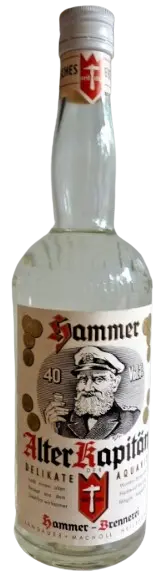
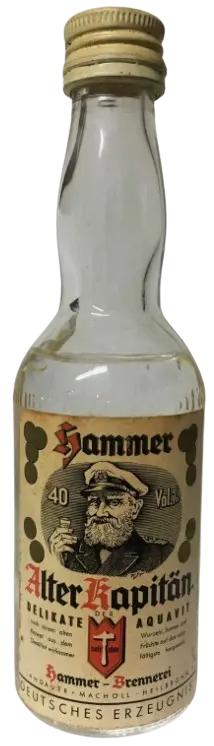
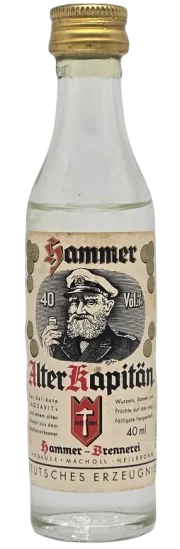
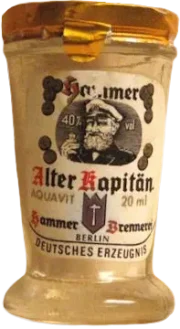
Hammer Alter Kapitän was a German aquavit produced by Hammer-Brennerei Landauer & Macholl in Heilbronn. The historical bottlings were sold at 40% alcohol by volume, including 0.7-litre bottles and 40 ml miniatures. An original advertisement dated 1969 shows that Alter Kapitän was part of the Hammer-Brennerei range by that time.
The label described Alter Kapitän as a delicate aquavit made according to an old recipe and referred to roots, seeds and fruits used in its production. The spirit was clear in appearance and featured a distinctive maritime label depicting a bearded sea captain. Production in Heilbronn ended with the closure of Hammer-Brennerei Landauer & Macholl in 1981.
After the closure, Berlin-based Mampe GmbH acquired the Hammer company name, trademarks and recipes and established Hammer Brennerei Berlin GmbH. Hammer spirits were produced in Berlin in 1981–1982, although the available historical source does not specifically identify Alter Kapitän among these Berlin bottlings. Mampe closed the operation after approximately two years.
The Alter Kapitän name subsequently reappeared as a German aquavit. The trademark ALTER KAPITÄN was registered in Germany to Lidl Stiftung & Co. KG in 1994 for spirits. By 2013, Alter Kapitän Aquavit was being produced by Pabst & Richarz for Lidl and was entered in the International Spirits Award in the Kümmel (Aquavit) category. Later Pabst & Richarz bottlings retained the 40% strength and were characterized by caraway as their principal botanical note. Alter Kapitän received Gold at the IWSC in 2014 and again in 2016.
Bottle gallery
About the producer
Hammer-Brennerei Landauer & Macholl
Heilbronn, Baden-Württemberg, Germany
Hammer-Brennerei Landauer & Macholl was founded in Heilbronn, Germany, in 1861 by Max Landauer. In 1866 his brother-in-law Leopold Macholl became a partner, and the company subsequently operated as Landauer & Macholl. The distillery expanded rapidly: its products received awards at international exhibitions in Vienna in 1873, Philadelphia in 1876 and Bordeaux in 1882. A new factory was built in Heilbronn in 1876 to accommodate the growing business.
In 1894 Landauer & Macholl registered the hammer emblem as its trademark. According to research published by the Heilbronn City Archive, it was the first registered trademark in the German spirits industry. The hammer subsequently became so closely associated with the company that it became widely known as Hammer-Brennerei. The company produced a large range of spirits and liqueurs; in 1900 it introduced Noisettes, described as the first German chocolate liqueur.
By the 1930s Hammer-Brennerei was one of Germany’s important spirits producers. In 1937 the company achieved a record turnover of 3.048 million Reichsmarks. A 1944 inventory recorded 19 stills with a combined capacity of 10,296 litres, spirit storage of 115,000 litres and total cask capacity of approximately 1.2 million litres.
The Landauer family was Jewish, and in 1938 the company was forcibly sold during the Nazi “Aryanization” of Jewish-owned businesses. The Heilbronn factory was almost completely destroyed in an air raid on 4 December 1944. After the war, Fritz Landauer returned to manage and rebuild the distillery, and ownership was formally restored to the Landauer family in 1950.
During the post-war period Hammer-Brennerei again became a major German spirits company. By the early 1960s it employed around 200 people, with another 150 working in field sales, maintained 28 distribution warehouses and had sales offices in Frankfurt and Berlin. Its products were distributed throughout West Germany and exported abroad.
After Fritz Landauer’s death in 1977, his son Werner took over the company. Economic changes in the spirits industry, increasing taxation, environmental requirements, limited space for further expansion and competition from inexpensive spirits contributed to the closure of Hammer-Brennerei in 1981. Berlin-based Mampe GmbH acquired the Hammer company name, trademarks and recipes and established Hammer Brennerei Berlin GmbH. Hammer products were manufactured in Berlin in 1981–1982, but Mampe itself closed shortly afterwards.