
Original Hamburger Aquavit
 Hamburg, Germany
- ABV
- 40%
- Base spirit
- Unknown
- Color
- Clear
- Style
- Unaged Aquavit
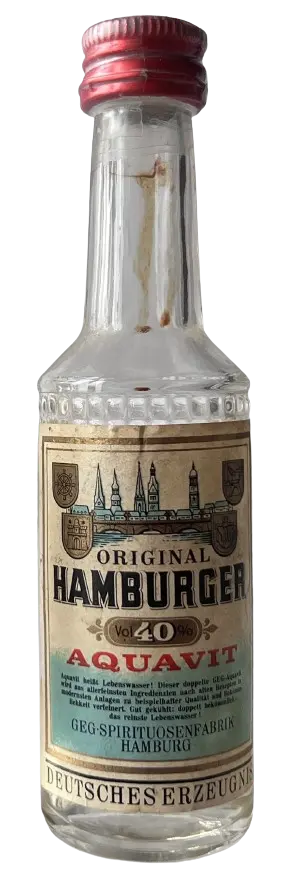
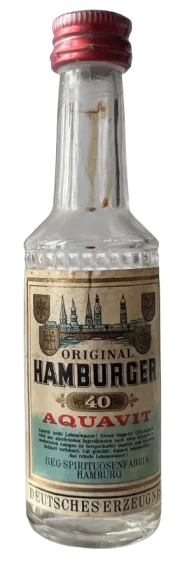
Original Hamburger Aquavit was a 40% ABV aquavit produced by GEG Spirituosenfabrik in Hamburg. Its label places particular emphasis on Hamburg, with a panorama of the city and several heraldic motifs. It also carries the producer designation “GEG-Spirituosenfabrik Hamburg” and the statement “Deutsches Erzeugnis” (“German product”). The spirit is clear and colorless.
The bottle is labelled Original Hamburger Aquavit, while a 1968 advertisement uses the shorter name Hamburger Aquavit. The label describes the product as “doppelter GEG-Aquavit” and states that it was prepared according to old recipes. It also recommends serving the aquavit well chilled. The word doppelter is part of the historical label wording and should not be taken as evidence of double distillation, since no distillation method is specified.
GEG had already been selling aquavit decades earlier. Hamburg newspaper advertisements from August 1928 list “Aquavit, 40%” among the company’s spirits alongside GEG liqueurs. The advertisements do not use the later Original Hamburger name, so they document an earlier GEG aquavit rather than establishing a launch date for this particular version.
By 1968, Hamburger Aquavit was specifically named in retail advertising. A KONSUM advertisement lists Hamburger Aquavit alongside GEG-Eiskorn, GEG-Weinbrand, GEG Dry Gin and GEG Doppelwacholder. The listing gives the bottle format as 1/1 Flasche; contemporary West German official documents use this designation for a 0.7-litre spirits bottle.
Bottle gallery
About the producer

GEG Spirituosenfabrik
Hamburg, Germany
GEG Spirituosenfabrik was the spirits-manufacturing operation of the Hamburg-based Großeinkaufs-Gesellschaft Deutscher Consumvereine, commonly known as GEG. The parent organization was formally established in Hamburg in March 1894 by consumer cooperatives seeking to organize purchasing collectively. From 1910 onward, GEG increasingly developed or acquired its own manufacturing operations, and its initials became a trademark associated with the organization’s own production.
The manufacturing network eventually covered a wide range of food and consumer goods. Historical accounts of GEG’s Hamburg operations specifically document a Spirituosenfabrik among the production facilities on the Peute industrial site; another historical directory records both GEG Spirituosenfabrik Hamburg and the full designation Großeinkaufs-Gesellschaft Deutscher Konsumgenossenschaften mbH Spirituosenfabrik Hamburg.
GEG was disrupted and dispossessed under the National Socialist regime, and its assets in the western occupation zones were later restored to the cooperative organization after the war. The GEG corporate structure continued into the post-war period until 1972, when it was converted into co op Zentrale Aktiengesellschaft.