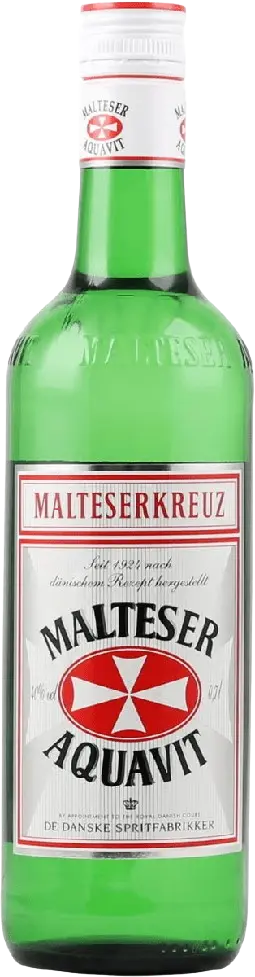
Kronenkreuz Tafel Aquavit
 Buxtehude, Lower Saxony, Germany
Kronenkreuz Tafel Aquavit was a German aquavit introduced by De Danske Spritfabrikker in 1975 and produced at the company’s Berlin operation. Its early positioning is confirmed by surviving advertising from 1976, which promoted the brand as: “Kronenkreuz – der neue Sanfte Tafel Aquavit” or “Kronenkreuz – the new mild Tafel Aquavit.” Although made in Germany primarily for the German market, it was based on an original Danish recipe.
Kronenkreuz was conceived as a lighter and milder alternative within the company’s aquavit range. Contemporary Danish material describes it as a “lys og mild snaps” – a light and mild snaps — while a specialist spirits reference places its flavour profile between Aalborg Taffel Akvavit and Aalborg Jubilæums Akvavit. Strength was 41% ABV.
A Berlin-Produced Aquavit
Kronenkreuz is also historically interesting because contemporary material specifically identifies it as a product of the Berlin factory. This provides useful evidence that De Danske Spritfabrikker continued aquavit production in Berlin during the 1970s, even while Buxtehude was becoming increasingly important to its German operations.
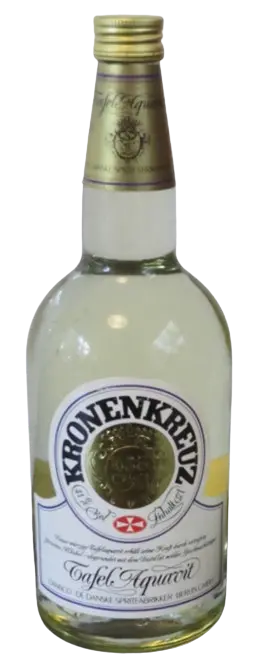
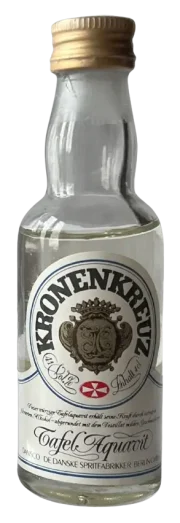
Historical bottles carry the Danisco · De Danske Spritfabrikker name and are easily distinguished by their clear glass, white-and-blue presentation and crowned Kronenkreuz emblem.
Kronenkreuz never achieved the market position of the company’s major aquavit brands; contemporary material specifically notes its relatively small market share. The exact date of discontinuation remains uncertain, but the brand is securely documented from the second half of the 1970s.
Bottle gallery
About the producer
De Danske Spritfabrikker Berlin GmbH
Buxtehude, Lower Saxony, Germany
De Danske Spritfabrikker Berlin GmbH was the German subsidiary of the Danish spirits company De Danske Spritfabrikker and for much of the twentieth century represented its interests in the German market.
The company was based in Berlin, where De Danske Spritfabrikker had established a German spirits operation during the 1920s. Its activities included the production, bottling and marketing of spirits, with Malteserkreuz Aquavit becoming by far its best-known product in Germany.
An important part of the company’s history is its long association with Danisco. This connection predates the major Danisco restructuring of 1989 by several decades. The name Danisco de Danske Spritfabrikker Berlin GmbH can be traced back at least to the 1950s, while the form Danisco – De Danske Spritfabrikker Berlin GmbH is documented in official Berlin archival material from 1974.
Historical bottles and advertising show several versions of the company name, including De Danske Spritfabrikker Berlin GmbH, Danisco – De Danske Spritfabrikker Berlin GmbH, and the abbreviated Danisco · DDSF Berlin GmbH. These variations reflect changes in corporate presentation and branding and should not necessarily be treated as separate producers.
Although Berlin remained part of the company name and was used as its corporate address, production activities increasingly involved the company’s facility in Buxtehude, Lower Saxony. Contemporary Danish material confirms that operations existed both in West Berlin and Buxtehude, making it important to distinguish the registered company identity from the actual production location.
During the 1990s the German operation was reorganized under the Danish Distillers identity, bringing the long period of the De Danske Spritfabrikker Berlin name to an end. Its successor companies continued to handle the group’s spirits business in Germany, eventually leading to V&S Deutschland GmbH.
For collectors, De Danske Spritfabrikker Berlin GmbH is particularly significant because its changing company names, abbreviations and Berlin addresses provide valuable clues for identifying and approximately dating historical bottlings.