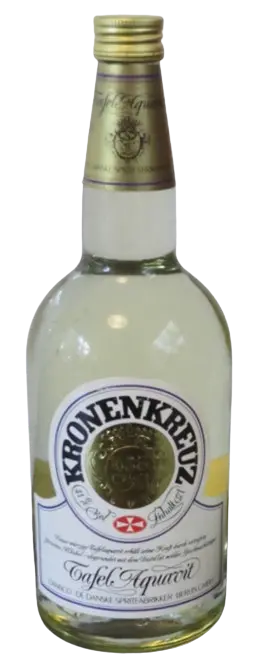
Malteserkreuz Aquavit
 Buxtehude, Lower Saxony, Germany
Malteserkreuz Aquavit is one of the great historic links between Danish aquavit tradition and German drinking culture. Created in Berlin in 1924 by the German operation of A/S De Danske Spritfabrikker, the company behind Aalborg aquavit, it spent most of the twentieth century being regarded as a thoroughly German brand despite its unmistakably Danish origins.
For generations, Malteserkreuz was a familiar name in German restaurants, bars and homes: a crystal-clear, caraway-driven aquavit, traditionally served eiskalt – ice-cold. During its long history it has been produced in Germany, Denmark and Norway, passed through several of Europe’s largest spirits groups, changed from 45% to 43% and finally 40% ABV, and appeared under both MALTESERKREUZ and the shortened MALTESER name.
More than a century after its introduction, Malteserkreuz remains in production and is today part of the Anora portfolio.
Born in Berlin in 1924
The origins of Malteserkreuz lie in the difficult trading conditions between Denmark and Germany after the First World War. Danish aquavit already had an established following in Germany, but high customs duties and import barriers made importing the finished spirit increasingly expensive.
De Danske Spritfabrikker therefore chose a practical solution: instead of shipping Danish aquavit into Germany, it would produce an aquavit locally according to its Danish know-how and recipe.
A production facility was established in Berlin, and the first Malteserkreuz Aquavit was released on 18 February 1924.
The connection with Aalborg was fundamental. Malteserkreuz was conceived in the tradition of the clear Danish aquavits for which De Danske Spritfabrikker was already famous, particularly Aalborg Taffel. In Germany, however, it developed an identity of its own and was marketed very deliberately as a German-made product based on Danish expertise.
This dual identity would remain with Malteserkreuz throughout its history: Danish in origin and recipe, but for decades deeply German in production, marketing and drinking culture.
The Maltese Cross
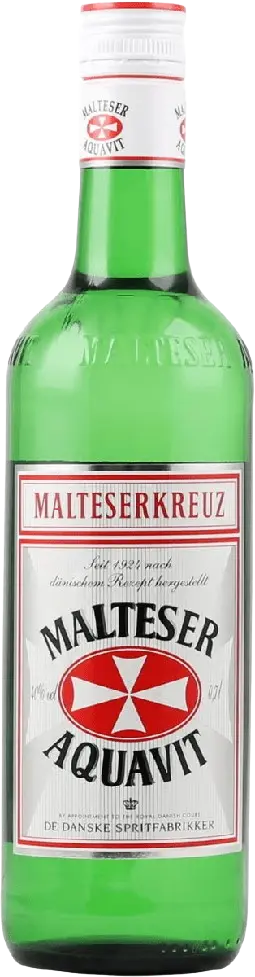
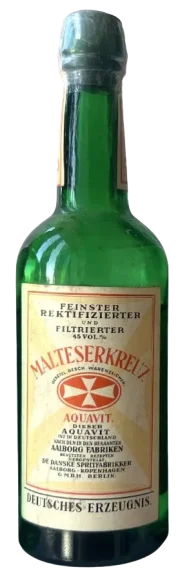
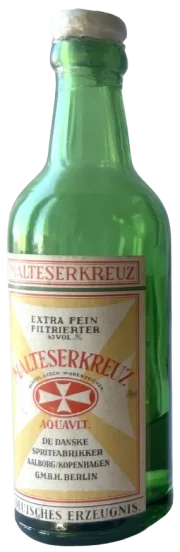
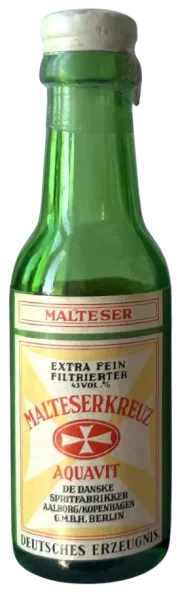
The name Malteserkreuz literally means “Maltese Cross”. The red-and-white cross became the central emblem of the brand and remained remarkably consistent even while almost every other element of the packaging changed.
The symbol was connected with the corporate and product identity surrounding De Danske Spritfabrikker and Aalborg. For Malteserkreuz it proved especially effective: the German name, green bottle and red-and-white cross created an instantly recognizable identity.
Over the decades the typography, bottle shape and presentation changed considerably, but the cross survived virtually everything – changes in alcohol strength, company names, ownership and countries of production.
The Style of Malteserkreuz
Malteserkreuz belongs to the clear, unaged school of aquavit. Its defining flavour is caraway, giving it the dry, spicy and unmistakably aquavit-like character associated with classic Danish taffel styles.
Historically it was described as a water-clear, unsweetened spirit made with fine caraway distillate and other flavouring ingredients. Later production descriptions referred to particularly finely filtered neutral spirit combined with a Würzedestillat – essentially an aromatic seasoning distillate.
The modern botanical profile includes caraway, dill, anise, fennel and coriander, preserving the distinctly herbal and savoury character of the brand.
Unlike barrel-aged Norwegian aquavit, Malteserkreuz was never defined by oak maturation. Its identity was built around clarity, purity, spice and an extremely cold serving temperature.
From 45% to 43% to 40%
Malteserkreuz was considerably stronger in its earlier form than it is today.
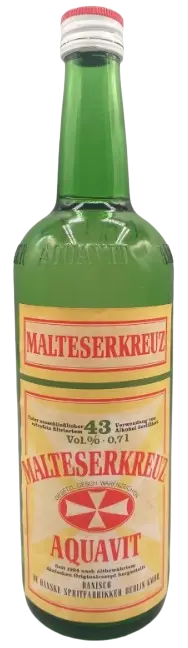
Historical bottlings exist at 45% ABV, including more than one generation of packaging. During the later twentieth century the strength was reduced to 43% ABV, and subsequently to 40% ABV, which became the modern standard.
The chronology can therefore be summarized as 45% → 43% → 40% ABV.
The precise date of every strength change is difficult to establish, particularly because packaging styles overlapped, but 45%, 43% and 40% are all unquestionably genuine Malteserkreuz bottling strengths.
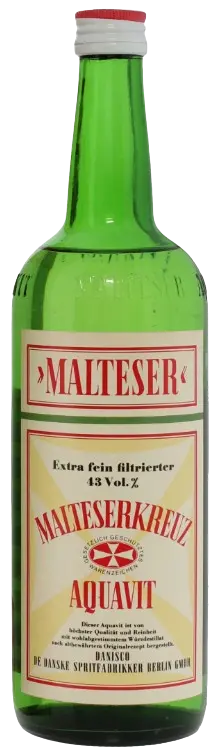
Interestingly, the change from 43% to 40% occurred without immediately transforming the visual identity of the product. Bottles with nearly identical designs can be found at both strengths.
MALTESERKREUZ and MALTESER
One particularly interesting chapter in the brand’s history is the variation between the names MALTESERKREUZ and simply MALTESER.
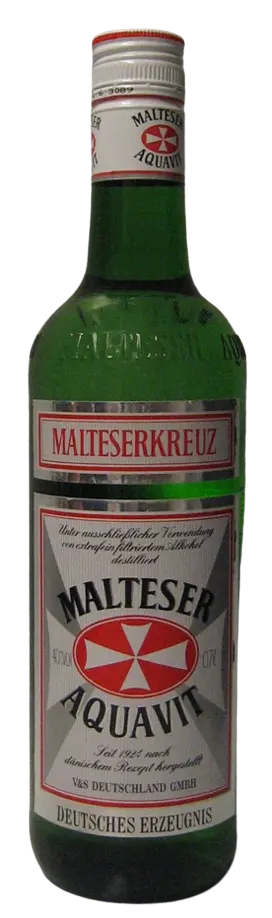
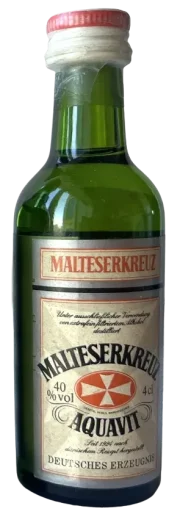
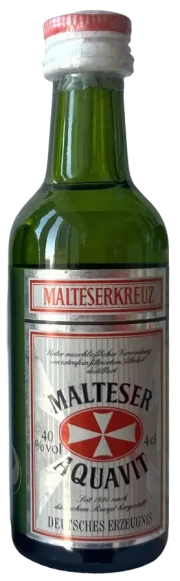
Earlier bottles prominently used MALTESERKREUZ, but during later periods the shorter MALTESER name appeared on the main label while the familiar Maltese Cross remained the visual centre of the design. Other versions returned to the full MALTESERKREUZ name.
This was not the creation of an entirely unrelated aquavit. Rather, it represents different phases in the presentation of the same established brand identity.
For collectors this makes Malteserkreuz particularly interesting. Two bottles can clearly belong to the same family while differing substantially in the way the brand name itself is displayed – Malteserkreuz, Malteser, or a combination in which the cross effectively substitutes for part of the visual identity.
“Eiskalt servieren!”
Perhaps nothing is more characteristic of Malteserkreuz than the instruction “EISKALT SERVIEREN!” – serve ice-cold.
Serving the aquavit extremely cold was not a recent suggestion added to modern marketing. It became one of the defining rituals of the brand.
Malteserkreuz was traditionally chilled thoroughly and served neat, often with beer and food. Recommendations over the years included cold platters, cheese and particularly rich or fatty dishes – exactly the sort of food against which a dry, aromatic caraway spirit works well.
At different times consumers were encouraged to keep Malteserkreuz in a freezer compartment or serve it in a special cooling sleeve. At 43% ABV, advertising even reassured drinkers that the bottle could safely be deeply chilled.
The combination of green bottle + red Maltese Cross + ice-cold aquavit became fundamental to the brand’s personality.
A Remarkable History of Advertising Slogans
Malteserkreuz developed a particularly strong advertising identity in post-war West Germany. Coldness was repeatedly turned into the central joke or promise of the campaigns.
- 1959 – “eisgekühlt – zu Vorspeisen und zum Bier” – “Ice-cold – with appetizers and beer.”
- 1962 – “eiskalt serviert, ein reiner Genuß” – “Served ice-cold – pure enjoyment.”
- 1964 – “eine völlig klare Sache” – “A perfectly clear choice.”
- 1969 – “zum Anwärmen – eiskalt!” – “To warm you up – ice-cold!”
- 1970s – “Das kalte Ereignis” – “The ice-cold experience.”
- around 1980 – “Der Eiskalte mit dem starken Charakter” – “The ice-cold one with a strong character.”
Some of these phrases also became part of the product presentation itself. Der Eiskalte zum Anwärmen is a particularly typical example of the playful contradiction that Malteserkreuz advertising liked to use: an ice-cold drink intended to “warm you up”.
During the 1980s the advertising increasingly relied on famous personalities. The campaign “Malteserkreuz Aquavit hat gute Freunde” featured well-known German figures, including football star Günter Netzer and actor Götz George.
An even more memorable line followed: “Man gönnt sich ja sonst nichts.” – “After all, you have to treat yourself to something.”
The slogan became strongly associated with Malteserkreuz in Germany. Campaigns featured personalities such as Manfred Krug, Günter Strack and Iris Berben, helping move the brand beyond straightforward spirits advertising and into German popular culture.
Malteserkreuz Production History
The production history of Malteserkreuz reflects more than a century of changing locations and ownership, from its origins in Berlin to its present-day production in Norway. The timeline below traces the key changes in producers, distilleries and production locations:
| Period | Producer / Company | Production Location | Country | Notes |
|---|---|---|---|---|
| 1924–1972 | De Danske Spritfabrikker, Aalborg-Kopenhagen GmbH | Berlin | Germany 🇩🇪 | Malteserkreuz was launched in Berlin on 18 February 1924. The German operation produced the aquavit according to a Danish recipe associated with De Danske Spritfabrikker and Aalborg. |
| 1972–c. 1974 | De Danske Spritfabrikker Berlin GmbH | Buxtehude, Lower Saxony | Germany 🇩🇪 | Production of Malteserkreuz was transferred to Buxtehude in 1972. This should not be interpreted as the closure of the Berlin factory: the Berlin operation continued to exist and is documented as producing other spirits later in the 1970s. |
| by 1974–c. 1990s | Danisco – De Danske Spritfabrikker Berlin GmbH | Buxtehude, Lower Saxony | Germany 🇩🇪 | The name Danisco – De Danske Spritfabrikker Berlin GmbH is documented during this period and also appears on historical Malteserkreuz bottlings, including the abbreviated form Danisco · DDSF Berlin GmbH. Malteserkreuz production was associated with Buxtehude, while the Berlin factory continued to operate separately; Kronenkreuz Tafel Aquavit, introduced in 1975, is specifically documented as a Berlin-produced aquavit. |
| by 1998–Apr 2003 | Danish Distillers Berlin GmbH | Buxtehude, Lower Saxony | Germany 🇩🇪 | By 1998, the German company was operating as Danish Distillers Berlin GmbH. Bottles from this period carry Berlin postal codes such as 10587 and later 10589. Production itself remained in Buxtehude. |
| Apr 2003–2011 | V&S Deutschland GmbH | Buxtehude, Lower Saxony | Germany 🇩🇪 | Danish Distillers Berlin GmbH was renamed V&S Deutschland GmbH in April 2003. Pernod Ricard acquired the V&S Group in 2008, but Malteserkreuz production remained in Buxtehude until the German production facility closed in 2011. |
| 2011–4 Jan 2013 | Pernod Ricard Denmark A/S | Aalborg | Denmark 🇩🇰 | The Buxtehude facility closed in 2011 and production of Malteserkreuz was transferred to Aalborg, Denmark. The brand was still part of the Pernod Ricard group. |
| 4 Jan 2013–Jun 2015 | Arcus Denmark A/S | Aalborg | Denmark 🇩🇰 | Arcus completed the acquisition of Malteserkreuz and the other former Danish Distillers brands on 4 January 2013. Arcus Denmark A/S operated the Aalborg production business, while bottling was handled externally in Svendborg. |
| Jun 2015–Sep 2021 | Arcus AS | Gjelleråsen, Nittedal | Norway 🇳🇴 | Production of Malteserkreuz, Aalborg Akvavit and Gammel Dansk was transferred from Aalborg to the Arcus facility at Gjelleråsen. The relocation was completed in June 2015. |
| Sep 2021–present | Anora / Arcus AS | Gjelleråsen, Nittedal | Norway 🇳🇴 | Arcus and Altia merged in September 2021 to form Anora Group. Malteserkreuz remained associated with the former Arcus production operation at Gjelleråsen. |
From Berlin to Buxtehude
For nearly half a century, Berlin was the original home of Malteserkreuz and the centre of De Danske Spritfabrikker’s German operation.
In 1972, production of Malteserkreuz was transferred to Buxtehude, Lower Saxony, which remained the brand’s principal German production site until 2011. However, this did not mean the end of production in Berlin: the factory continued to operate, and Kronenkreuz Tafel Aquavit, introduced in 1975, is specifically documented as being produced there.
Berlin also remained important as a corporate centre. As a result, names such as Danisco – De Danske Spritfabrikker Berlin GmbH, Danisco · DDSF Berlin GmbH and later Danish Distillers Berlin GmbH continued to appear on bottles even when Malteserkreuz itself was produced in Buxtehude.
The company name and address on a historical bottle therefore do not necessarily indicate its actual place of production.
De Danske Spritfabrikker and Danisco
The corporate history surrounding Malteserkreuz became increasingly complex during the second half of the twentieth century.
Its original parent, De Danske Spritfabrikker, had been formed in Denmark in 1881 and eventually consolidated a large part of Danish distilling under one company. Aalborg aquavit became its best-known international product family.
The Danisco name had been associated with the German operation for decades before the major corporate restructuring of 1989. The company name Danisco – De Danske Spritfabrikker Berlin GmbH is documented in historical records well before that date, including a Berlin archival record from 1974.
The same corporate identity can also be found directly on historical Malteserkreuz bottles. Depending on the period and label design, it appeared both in the full form Danisco – De Danske Spritfabrikker Berlin GmbH and in the abbreviated form Danisco · DDSF Berlin GmbH. Other bottlings simply carry De Danske Spritfabrikker Berlin GmbH, illustrating that the wording used on labels was not always completely uniform.
In 1989, De Danske Spritfabrikker became part of the newly consolidated Danisco group. This was an important change in the wider corporate structure, but it should not be interpreted as the beginning of the Danisco name on Malteserkreuz or within the German operation.
Throughout this period, Berlin continued to appear in the company name and address even though physical production of Malteserkreuz had already moved to Buxtehude in 1972. The company name printed on a bottle therefore identifies the German corporate operation, but does not necessarily identify the actual place of production.
V & S and Danish Distillers
By the late 1990s, the German operation was increasingly identified through the English-language Danish Distillers and Danisco Distillers names. Malteserkreuz bottles from this period can be found carrying Danish Distillers Berlin GmbH, together with five-digit Berlin postal addresses such as 10587 and later 10589 Berlin.
The latter is particularly well documented: in 1998, Danish Distillers Berlin GmbH was recorded at Ilsenburger Straße 15/16, D-10589 Berlin in connection with Malteserkreuz.
Another major corporate change came in 1999, when the spirits business was acquired by the Swedish state-owned V&S Vin & Sprit, best known internationally as the owner of Absolut Vodka.
Germany had introduced its five-digit postal code system in 1993, making the postal addresses found on bottles particularly useful for dating later Malteserkreuz variants.
In April 2003, Danish Distillers Berlin GmbH was renamed V&S Deutschland GmbH. Malteserkreuz nevertheless continued to be produced in Buxtehude.
Again, “Berlin” at this stage referred primarily to the German corporate and commercial operation, rather than to the physical location where the aquavit was produced.
Pernod Ricard
In 2008, French drinks group Pernod Ricard acquired V&S, primarily in order to obtain Absolut Vodka. Malteserkreuz consequently became part of the Pernod Ricard portfolio as part of the same transaction.
The arrangement did not last very long.
Pernod Ricard subsequently decided to dispose of several Nordic heritage spirits brands. In 2012, an agreement was reached to sell Aalborg, Brøndums, Gammel Dansk and Malteserkreuz to Norwegian spirits producer Arcus-Gruppen.
The transaction, valued at approximately €103 million, was completed on 4 January 2013.
For Malteserkreuz, this effectively reunited its future with a company specializing heavily in Nordic aquavit.
The End of German Production
An even more significant change had already occurred shortly before the Arcus acquisition.
In 2011, production in Buxtehude ended after almost forty years. Malteserkreuz production was transferred to Aalborg, Denmark.
This was historically significant. After approximately 87 years of German production – first in Berlin and then in Buxtehude – Malteserkreuz was now physically being made in the country from which its original recipe and aquavit tradition had come.
The return to Denmark, however, was short-lived.
From Aalborg to Norway
After Arcus took control of the former Danish Distillers brands, it reorganized production.
In 2015, production and bottling of Aalborg Akvavit, Gammel Dansk and Malteserkreuz were transferred from Aalborg to the Arcus facility at Gjelleråsen in Norway, near Hagan. The relocation was completed in June 2015.
Few classic aquavit brands illustrate the increasingly international nature of Nordic spirits production quite so clearly. Malteserkreuz began as a Danish-inspired aquavit made in Germany, briefly returned to Denmark, and ultimately moved to Norway.
There is a slight modern ambiguity here because Malteserkreuz continues to be commercially described as a Danish aquavit in some markets, reflecting its recipe and heritage. That description should not necessarily be interpreted as meaning that every modern bottle is physically produced in Denmark.
Arcus Becomes Anora
The final major ownership change came in 2021.
Norwegian Arcus merged with Finnish drinks group Altia, creating Anora Group. The merger was completed on 1 September 2021.
Malteserkreuz therefore became part of Anora’s large Nordic portfolio alongside many other historic Scandinavian spirits brands, while its production remained associated with the former Arcus operation at Gjelleråsen in Norway.
In Germany, where Malteserkreuz has historically had its most important market, distribution arrangements have also continued to evolve. Since June 2024, distribution has been handled by Diversa Spezialitäten GmbH and TeamSpirit, both part of the Underberg Group, under an expanded partnership with Anora.
Despite its Danish heritage, German origins and later Norwegian production, Germany remains central to the identity and commercial history of Malteserkreuz.
Malteser No. 2
The Malteser name was also used for an interesting companion product: Malteser No. 2.
Introduced in 1999, around the 75th anniversary of Malteserkreuz, No. 2 represented a deliberately lighter interpretation of the concept.
Unlike the classic Malteserkreuz in its traditional green bottle, Malteser No. 2 appeared in clear glass and was bottled at 37.5% ABV. It was described as edel – fein – mild and positioned as a softer aquavit suited to modern, lighter cuisine and delicate starters.
It was produced and bottled in Denmark and marketed through the German Danish Distillers organization.
Malteser No. 2 never displaced the original. Instead, it existed as a milder alternative alongside it and appears to have disappeared around the end of the 2000s.
Today it is an interesting footnote in the history of the brand – and a useful reminder that Malteserkreuz was not entirely static during the late twentieth and early twenty-first centuries.
A German Aquavit with a Danish Soul
Trying to assign Malteserkreuz to a single national tradition is surprisingly difficult.
It was conceived by a Danish distilling company, based on Danish aquavit expertise and closely connected with Aalborg. Yet it was created specifically for Germany, first produced in Berlin, labelled and advertised as a German product, and manufactured in Germany for most of the twentieth century.
Its drinking ritual also became distinctly German: ice-cold Malteserkreuz, often accompanied by beer and hearty food.
Then, after almost nine decades, production returned briefly to Denmark before moving with other historic Danish spirits to Norway.
In that sense Malteserkreuz is best understood not simply as German or Danish aquavit, but as a product of the long relationship between the two traditions.
More Than a Century of Malteserkreuz
Malteserkreuz reached its 100th anniversary in 2024.
Over that century it survived the upheavals of German and European history, several changes of factory, repeated corporate takeovers, changes of company name, reductions in alcoholic strength and major shifts in spirits advertising and consumer tastes.
Yet its basic identity remained remarkably recognizable.
It is still a clear, caraway-led aquavit. The Maltese Cross remains at the heart of the brand. The spirit is still associated with being served extremely cold. And the lineage still leads directly back to the Danish aquavit tradition and the Berlin launch of 1924.
From 45% Malteserkreuz produced in Germany to today’s 40% version under Anora, the brand represents more than a hundred years of shared Danish and German aquavit history.
Bottle gallery
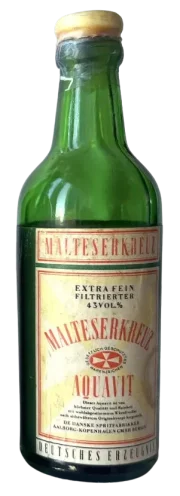
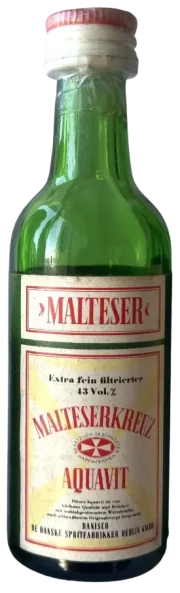
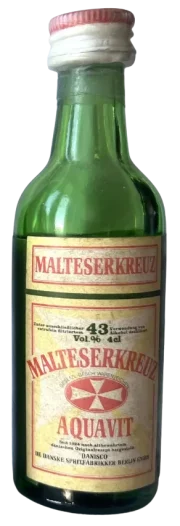
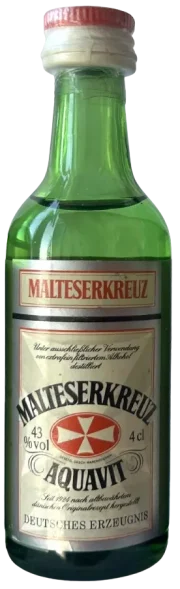
About the producer
De Danske Spritfabrikker Berlin GmbH
Buxtehude, Lower Saxony, Germany
De Danske Spritfabrikker Berlin GmbH was the German subsidiary of the Danish spirits company De Danske Spritfabrikker and for much of the twentieth century represented its interests in the German market.
The company was based in Berlin, where De Danske Spritfabrikker had established a German spirits operation during the 1920s. Its activities included the production, bottling and marketing of spirits, with Malteserkreuz Aquavit becoming by far its best-known product in Germany.
An important part of the company’s history is its long association with Danisco. This connection predates the major Danisco restructuring of 1989 by several decades. The name Danisco de Danske Spritfabrikker Berlin GmbH can be traced back at least to the 1950s, while the form Danisco – De Danske Spritfabrikker Berlin GmbH is documented in official Berlin archival material from 1974.
Historical bottles and advertising show several versions of the company name, including De Danske Spritfabrikker Berlin GmbH, Danisco – De Danske Spritfabrikker Berlin GmbH, and the abbreviated Danisco · DDSF Berlin GmbH. These variations reflect changes in corporate presentation and branding and should not necessarily be treated as separate producers.
Although Berlin remained part of the company name and was used as its corporate address, production activities increasingly involved the company’s facility in Buxtehude, Lower Saxony. Contemporary Danish material confirms that operations existed both in West Berlin and Buxtehude, making it important to distinguish the registered company identity from the actual production location.
During the 1990s the German operation was reorganized under the Danish Distillers identity, bringing the long period of the De Danske Spritfabrikker Berlin name to an end. Its successor companies continued to handle the group’s spirits business in Germany, eventually leading to V&S Deutschland GmbH.
For collectors, De Danske Spritfabrikker Berlin GmbH is particularly significant because its changing company names, abbreviations and Berlin addresses provide valuable clues for identifying and approximately dating historical bottlings.